Acting on a vow to fight the Obama administration on climate issues, Rep. Fred Upton (R-Mich.), chairman of the House Energy and Commerce Committee, unveiled draft legislation Wednesday to try to strip the Environmental Protection Agency of its power to regulate greenhouse gases under the Clean Air Act.
Sen. James M. Inhofe (Okla.), ranking Republican on the Senate Committee on Environment and Public Works, and Rep. Ed Whitfield (R-Ky.), chairman of the subcommittee on energy and power, joined Upton in issuing what they called the Energy Tax Prevention Act.
In a statement, the congressmen said the legislation's intent is to show that the Clean Air Act was not meant to address climate change, stop the EPA "from imposing a backdoor cap-and-trade tax" on industries identified as polluters, and protect American jobs.
"We firmly believe federal bureaucrats should not be unilaterally setting national climate change policy," the statement said.
The EPA issued a finding in late 2009 that said greenhouse gas emissions linked to global warming endanger the public's health and welfare. Last month, the agency told industrial facilities such as power plants, oil refineries and paper mills that require permits to emit sulfur dioxide and nitrous oxide to also account for greenhouse gas emissions if they expand or add construction that significantly increases greenhouse gas pollution.
Republicans, many of whom doubt climate-change science, say the regulations hurt the ability of U.S. manufacturers to compete against companies in countries with relaxed standards.
The EPA has its foot "squarely on the neck of business," Upton has said. Republicans say the Obama administration is trying to use tougher EPA regulations on energy to overcome the president's failure to pass climate-change legislation.
Read More: House GOP readies bill to prohibit EPA from regulating carbon emissions

Showing posts with label Environment. Show all posts
Showing posts with label Environment. Show all posts
Thursday, February 3, 2011

Monday, October 4, 2010
Friday, October 1, 2010
10:10 Climate Change Campaign creator's actions proves the campaign's uselessness (Video)
 |
| Franny "Super Carbon" Armstrong |
Fran has been quoted as saying, "If you're not fighting climate change or improving the world, you're wasting your life."
Funny that the only way she could "improve" the world was by burning enough carbon to fuel a small village.
The audacity of these people is stunning. They can rationalize almost any behaviour as long as it gets them to their end result. Does it make sense to increase your carbon footprint by 10 fold, in order create a movie to encourage people to reduce their carbon footprint?
Makes no sense. Unless your making money.
This idiot logic is so outside the realm of sanity that it might need a referral for medication.
Tuesday, June 22, 2010
Obama's Moratorium On Drilling Slapped Down By A Federal Judge
Judge block Gulf offshore drilling moratorium
 NEW ORLEANS — A federal judge in New Orleans has blocked a six-month moratorium on new deepwater drilling projects that was imposed in response to the massive Gulf oil spill.
Several companies that ferry people and supplies and provide other services to offshore drilling rigs had asked U.S. District Judge Martin Feldman in New Orleans to overturn the moratorium.
President Barack Obama’s administration has halted the approval of any new permits for deepwater drilling and suspended drilling at 33 exploratory wells in the Gulf.
Feldman says in his ruling that the Interior Department failed to provide adequate reasoning for the moratorium. He says it seems to assume that because one rig failed, all companies and rigs doing deepwater drilling pose an imminent danger.
Gulf Coast Oil Spill

Several companies that ferry people and supplies and provide other services to offshore drilling rigs had asked U.S. District Judge Martin Feldman in New Orleans to overturn the moratorium.
President Barack Obama’s administration has halted the approval of any new permits for deepwater drilling and suspended drilling at 33 exploratory wells in the Gulf.
Feldman says in his ruling that the Interior Department failed to provide adequate reasoning for the moratorium. He says it seems to assume that because one rig failed, all companies and rigs doing deepwater drilling pose an imminent danger.
Gulf Coast Oil Spill
Thursday, June 17, 2010
Sierra Club, others sue to stop Miss. Power plant
The Sierra Club filed a lawsuit Thursday trying to stop Mississippi Power Co. from developing a coal-fired, electric-generating plant in the east central part of the state.
The lawsuit was filed in coastal Harrison County Chancery Court.
In May, the state Public Service Commission voted 2-1 to ease restrictions it had put on the Kemper County plant.
Sierra Club state director Louie Miller described that decision as a "flip flop." He said it would allow Mississippi Power to charge rate payers for the costs of the plant before it's even built.
Miller said the PSC refused to order Mississippi Power to disclose how much customers will pay in rates for the new plant.
"Agreeing to unknown increased electric rates for Kemper is like buying a car when the salesman won't tell you what it costs," Miller said in a statement. "This is an outrage and betrayal of the public trust."
Mississippi Power officials had no immediate comment. The lawsuit represents only one side of a legal argument.
Mississippi Power, a subsidiary of the Atlanta-based Southern Co., has said the plant would use a new technology that converts lignite into a gas that would fuel turbines to create electricity. Company officials said the lignite would be locally mined and would be cheaper than natural gas.
The utility said more than 4 billion tons of lignite are underground near the plant site, and it has options on 30,000 acres.
The proposed 582-megawatt plant is expected to begin generating power by 2014, according to the utility.
Mississippi Power officials say the plant will create 260 permanent jobs and 1,000 jobs during the construction phase.
Associated Press
The lawsuit was filed in coastal Harrison County Chancery Court.
In May, the state Public Service Commission voted 2-1 to ease restrictions it had put on the Kemper County plant.
Sierra Club state director Louie Miller described that decision as a "flip flop." He said it would allow Mississippi Power to charge rate payers for the costs of the plant before it's even built.
Miller said the PSC refused to order Mississippi Power to disclose how much customers will pay in rates for the new plant.
"Agreeing to unknown increased electric rates for Kemper is like buying a car when the salesman won't tell you what it costs," Miller said in a statement. "This is an outrage and betrayal of the public trust."
Mississippi Power officials had no immediate comment. The lawsuit represents only one side of a legal argument.
Mississippi Power, a subsidiary of the Atlanta-based Southern Co., has said the plant would use a new technology that converts lignite into a gas that would fuel turbines to create electricity. Company officials said the lignite would be locally mined and would be cheaper than natural gas.
The utility said more than 4 billion tons of lignite are underground near the plant site, and it has options on 30,000 acres.
The proposed 582-megawatt plant is expected to begin generating power by 2014, according to the utility.
Mississippi Power officials say the plant will create 260 permanent jobs and 1,000 jobs during the construction phase.
Associated Press
Tuesday, May 11, 2010
Dead dolphins wash up on coast; oil's role unclear
Associated Press
SHIP ISLAND, Miss. — Federal wildlife officials are treating the deaths of six dolphins on the Gulf Coast as oil-related even though other factors may be to blame.
Blair Mase (MACE') of the National Marine Fisheries Service said Tuesday that the carcasses have all been found in Louisiana, Mississippi and Alabama since May 2. Samples have been sent for testing to see whether a massive oil spill in the Gulf of Mexico helped kill the dolphins.
Mase and animal rescue coordinator Michele Kelley in Louisiana said none of the carcasses has obvious signs of oil. Mase also said it's common for dead dolphins to wash up this time of year when they are in shallow waters to calve.
The Associated Press found dolphins swimming and playing in oily waters off Louisiana last week.
Cross Posted at Lucy's Revenge
SHIP ISLAND, Miss. — Federal wildlife officials are treating the deaths of six dolphins on the Gulf Coast as oil-related even though other factors may be to blame.
Blair Mase (MACE') of the National Marine Fisheries Service said Tuesday that the carcasses have all been found in Louisiana, Mississippi and Alabama since May 2. Samples have been sent for testing to see whether a massive oil spill in the Gulf of Mexico helped kill the dolphins.
Mase and animal rescue coordinator Michele Kelley in Louisiana said none of the carcasses has obvious signs of oil. Mase also said it's common for dead dolphins to wash up this time of year when they are in shallow waters to calve.
The Associated Press found dolphins swimming and playing in oily waters off Louisiana last week.
Cross Posted at Lucy's Revenge
Seeds of Discontent: Monsanto defends genetic modification practices

Seed-drilling machinery on the Derrinallum property Sheehan manages works day and night across the flat crop-land to inject the soil with with science. It is the season to plant grains such as wheat and canola and - for the first time this year - an estimated 20 per cent of the canola crop in Victoria will come from one of the most sophisticated levels of scientific endeavour: genetic modification.
But despite the huge uptake by Victorian farmers, this might be the last year Sheehan uses the controversial technology. For him, the outcome has not matched the promise.
Although GM canola has been planted since 1995 in Canada - where it was developed - many other countries, including Australia, had a moratorium on planting the crop due to public disquiet about perceived dangers.
The list of concerns was long, ranging from unease about the possible allergic effects of new untested proteins on humans, to worries the plants could affect other crops and transfer their genetically modified characteristics to weeds.
In the first year after Victoria and New South Wales dropped the moratorium in late 2007, support for the technology was tentative, but plantings have rocketed since. This season, sales of GM canola seed across the country have more than doubled compared with last year. And Victoria farmers appear to be the nation's most enthusiastic, with by far the largest plantings of the three states in which the technology is allowed.
Monsanto is the US-based chemical and biotechnology company that holds the patents on all GM canola grown in this country. It expects 40,000 hectares to be planted in Victoria this year, up from less than 28,000 last year. Nationally, the area cultivated for this type of crop is expected to more than double to 89,000 hectares, thanks to Western Australia dropping its moratorium following the election of the Barnett Liberal government.
David Tribe is a Melbourne University scientist and an energetic advocate for GM technology. He also runs a blog called GMO Pundit that has devoted considerable energy to confronting GM opponents. In conjunction with American academic Bruce Chassy, Tribe has launched a detailed attack on one of America's most high-profile GM critics, Jeffrey Smith, whose book Seeds of Deception has been a best seller.
The book, which takes particular aim at Monsanto, claims the company has historically combined some of the most toxic products ever sold with misleading reports, pressure tactics on opponents and collusion with friendly government scientists.
It asserts the company and its competitors now race to genetically engineer and patent the world's food supply, which Smith says profoundly threatens our health, environment, and economy.
Tribe believes that such claims, while popular, are easily debunked and have never been subjected to scientific peer review.
He believes that in the long term, genetically modified organisms will better suit the needs of agriculture, and are the only way to feed an increasing global population amid the uncertainties thrown up by climate change.
''Many of the opponents of GM take that position because they simply dislike large companies, but they are not facing the problem that our agriculture system will need to feed billions more people.
''If global warming is the greatest moral challenge of our time, then we have to confront it. Many of the opponents [of GM] have a fundamentalist ideological vision of the world, and over history fundamentalist ideologies have killed millions of people.''
Sheehan could be seen to be a similar enthusiast. He planted the first crop as soon as the moratorium was lifted and this is the third year in which he has used the seed known as Monsanto's Roundup Ready. Its characteristic is a modification to allow it to survive being sprayed by the herbicide glyphosate, which Monsanto markets under the Roundup brand.
Despite the claims of increased yields from GM proponents, Sheehan has recorded no such increase. What he has noticed is a much higher cost of using GM canola than using TT varieties. Roundup Ready canola costs $25 a kilogram, whereas TT costs about $4 - although this is modified by the amount needed to be planted.
''With TT you have to plant about five kilos to the hectare whereas with Roundup Ready and Clearfield, you only have to plant three.
''But the real problem with Roundup Ready is the very limited window allowed for weed spraying. You can only spray the plants when they have between two and six leaves … There are times when you might need to spray if weeds develop when the plants have 12 leaves, but if you do that you really knock them around. This [limitation] has really taken the gloss off GM.''
Read more at The Age
Friday, April 23, 2010
Sun Herald: Oil spill may hit Coast

Coast Guard and oil company officials at a news conference Thursday said it was not clear whether the 18,000-foot-deep well was still leaking.
Environmental threats include the 336,000 gallons of oil a day that had been spurting from the rig before it sank, though nearly all of it was burning off in the incessant fire, Coast Guard firefighter Katherine McNamara told the Associated Press.
Coast Guard cutters Zephyr, a patrol boat homeported in Pascagoula, and Cobia, a patrol boat out of Mobile, are involved in the search for 11 rig workers missing since the explosion.
Coast Guard Rear Adm. Mary E. Landry said that the probability of the crewmembers’ survival was decreasing, despite warm waters and calm seas.
At least 700,000 gallons of diesel fuel was in a tank on the rig, but that could have been consumed in the fire before the rig sank, said Doug Helton, incident operations coordinator for the National Oceanographic and Atmospheric Administration’s office of response and restoration.
“The diesel fuel, if it didn’t burn off, will evaporate and not come to shore,” he said.
The crude oil leaking from the newly drilled well is heavier and will last longer.
“It could float around long enough to reach the shore,” he said.
Sun Herald
Thursday, April 22, 2010
Earth Day 2010: More about blame, than conservation and stewardship.


Excuse me if I don't act surprised. It is hardly news that everyone wants hard choices to be made, but very few people want to be the ones to make the sacrifices themselves.
When it came to wasteful spending former Senator Trent Lott once said "Pork is anything spent north of Memphis." The same mindset holds true for those who would otherwise be enviromentally friendly.
Case in point: The New York City sightseeing company Gray Line is promoting an “Earth Week” package of day trips that includes visits to “green spots” like the botanical gardens and flower shopping at Chelsea Market. The fact that these tours will be taken on buses running on fossil fuels does not sit well with the first Earth Day national coordinator Denis Hayes who tells The New York Times what he thinks of such green consumerism: “This ridiculous perverted marketing has cheapened the concept of what is really green. It is tragic.”
Even the Old Gray Lady can't help but notice:
At 40, Earth Day Is Now Big Business
So strong was the antibusiness sentiment for the first Earth Day in 1970 that organizers took no money from corporations and held teach-ins “to challenge corporate and government leaders.”
Forty years later, the day has turned into a premier marketing platform for selling a variety of goods and services, like office products, Greek yogurt and eco-dentistry.
And then there is the left’s push for economy-killing energy taxes. The Heritage Foundation’s Center for Data Analysis has found that cap-and-tax legislation pending in Congress would cost the average family-of-four almost $3,000 per year, cause 2.5 million net job losses by 2035, and a produce a cumulative gross domestic product (GDP) loss of $9.4 trillion between 2012 and 2035. Losing that $9.4 trillion to appease the fragile sensibilities of the enviro-left – now that would be tragic.
Especially when one considers that studies clearly show that important indicators of environmental quality actually improve as incomes and levels of consumption go up.
I, for one, would be more than happy to stop increasing my carbon footprint if the government would get the hell out of my money. If I were able to keep more of it, I wouldn't have the need to be constantly burning fossil fuels to find more.
Finally, there is the growing sentiment that we've all been lied to. It's becoming hard to believe traditional media sources as they continue to hype the same old argument despite the 900-pound gorilla sitting behind Katie Couric.
It’s been a rough five months for the credibility of many of the “leading” climate scientists.
First, the ClimateGate e-mails appeared to show unethical or illegal behavior of high profile scientists and a potential conspiracy to distort science for political gain. These weren’t just a few renegade scientists; in the following months, damning information came to light about the world’s leading climate alarmists and their work with the Intergovernmental Panel on Climate Change (IPCC), the Stern Report, the U.S. National Climate Data Center and even NASA.
Even with the 40th anniversary of Earth Day coming up on April 22, Americans are skeptical about the threat of climate change. A March 2010 Gallup poll found that 48 percent of Americans think the threat of global warming is “generally exaggerated". That’s the highest in 13 years, according to Gallup.
The public’s receding fear of climate change may be related to the series of scandals and admissions that have been uncovered since Nov. 20 when e-mails from University of East Anglia’s Climatic Research Unit (CRU) were leaked. Those e-mails provided “ammunition” to climate skeptics about the authenticity and ethics surrounding the CRU’s work on global warming science.
Including this very damning email:
From: Phil Jones
To: ray bradley ,mann@XXXX, mhughes@XXXX
Subject: Diagram for WMO Statement
Date: Tue, 16 Nov 1999 13:31:15 +0000
Cc: k.briffa@XXX.osborn@XXXX
Dear Ray, Mike and Malcolm,
Once Tim’s got a diagram here we’ll send that either later today or first thing tomorrow.
I’ve just completed Mike’s Nature trick of adding in the real temps to each series for the last 20 years (ie from 1981 onwards) amd from 1961 for Keith’s to hide the decline. Mike’s series got the annual land and marine values while the other two got April-Sept for NH land N of 20N. The latter two are real for 1999, while the estimate for 1999 for NH combined is +0.44C wrt 61-90. The Global estimate for 1999 with data through Oct is +0.35C cf. 0.57 for 1998.
Thanks for the comments, Ray.
Cheers
Phil
Prof. Phil Jones
Climatic Research Unit Telephone XXXX
School of Environmental Sciences Fax XXXX
University of East Anglia
Norwich
As for me and my house, we'll continue to do the very things my family and my faith has always taught me to do; be good stewards of the resources the Lord has provided. At the same time, I will try to get away, hide and otherwise stop those who would take those resources away to give them to someone else who refuses to take the same responsibility for themselves.
Thursday, April 1, 2010
The Foundry: Don’t Be Fooled by Obama’s Offshore Drilling Announcement
The increased economic activity from heavily-populated developing nations like India and China indicates that the demand for oil is likely to increase well into the future. The least we can do is step aside and let companies determine whether these projects are economically feasible.
President Obama said in his announcement today that “This is not a decision that I’ve made lightly.” It should have been. Offshore drilling will create jobs and increase energy supplies without cost to the taxpayer. It will create revenues for financially strapped state governments and increase revenues for federal governments. Unfortunately, we won’t realize many of these benefits because this decision was more about getting “drilling” in the headlines than in our nation’s waters.
The Foundry
President Obama said in his announcement today that “This is not a decision that I’ve made lightly.” It should have been. Offshore drilling will create jobs and increase energy supplies without cost to the taxpayer. It will create revenues for financially strapped state governments and increase revenues for federal governments. Unfortunately, we won’t realize many of these benefits because this decision was more about getting “drilling” in the headlines than in our nation’s waters.
The Foundry
Wednesday, March 31, 2010
Drill Here? Study, plan, authorize . . . maybe.

Obama to Open Offshore Areas to Oil Drilling for First Time
The Obama administration is proposing to open vast expanses of water along the Atlantic coastline, the eastern Gulf of Mexico and the north coast of Alaska to oil and natural gas drilling, much of it for the first time, officials said Tuesday.
The proposal---a compromise that will please oil companies and domestic drilling advocates but anger some residents of affected states and many environmental organizations — would end a longstanding moratorium on oil exploration along the East Coast from the northern tip of Delaware to the central coast of Florida, covering 167 million acres of ocean.
Under the plan, the coastline from New Jersey northward would remain closed to all oil and gas activity. So would the Pacific Coast, from Mexico to the Canadian border.
The environmentally sensitive Bristol Bay in southwestern Alaska would be protected and no drilling would be allowed under the plan, officials said. But large tracts in the Chukchi Sea and Beaufort Sea in the Arctic Ocean north of Alaska — nearly 130 million acres — would be eligible for exploration and drilling after extensive studies.
But the devil is always in the details. The report says that:
"the administration plans to adopt some drilling proposals floated by President George W. Bush."
Note: that the administration plans to adopt some not all. The report goes on to say that officials say:
"The first lease sale off the coast of Virginia could occur as early as next year in a triangular tract 50 miles off the coast."
Or it could occur as let as never. Why? Because the Interior Department
"will spend several years conducting geologic and environmental studies along the rest of the southern and central Atlantic Seaboard. If a tract is deemed suitable for development, it is listed for sale in a competitive bidding system. The next lease sales — if any are authorized by the Interior Department — would not be held before 2012."
Don't know about you, but I find that to be a lot of what if's, kinda sorta's, and maybe's in return for a vote for another large tax increase in the form of Cap and Trade.
As Moe Lane puts it:
"the White House is implying the promise of jam tomorrow - in reality, it’s just a study to revisit the denial of jam yesterday - in exchange for jam today. Only the jam today is actually a swarm of angry wasps. Try again, Mr. President. Start with rescinding your interference with the Bush drilling permits, and expect to give up more. A lot more: your opponents are not interested in indulging the Greenies’ quaint, somewhat primitive religious sensibilities."
In other words, an operator’s ability to drill and explore a lease is subject to his ability to secure the requisite approval from the various government agencies that issue permits for that activity. So, theoretically, the Feds could issue a lease, but if one of the regulatory bodies refuses to issue a permit, there’s no drilling.
And, guess what? It already happened last month.
Montana oil leases suspended
BILLINGS – A federal judge has approved a first-of-its-kind settlement requiring the government to suspend 38,000 acres of oil and gas leases in Montana so it can gauge how oil field activities contribute to climate change. …
Under the deal approved Thursday by U.S. District Judge Donald Molloy in Missoula, the Bureau of Land Management will suspend the 61 leases in Montana within 90 days. They will have to go through a new round of environmental reviews before the suspensions can be lifted.
A parallel lawsuit challenging 70,000 acres of federal lands leased in New Mexico remains pending.
Put simply this is a scheme to regain support for a Cap and Trade proposal that as of this moment appears to be dead. To fall for anything this administration proposes at this point is a mistake. Just Say No to everything until November. Then begin the conversation anew.
Friday, March 26, 2010
‘Cap and Trade’ Loses Its Standing as Energy Policy of Choice
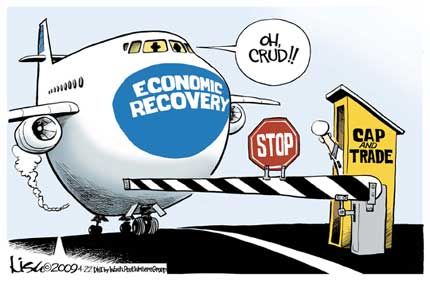
Less than a year ago, cap and trade was the policy of choice for tackling climate change.
Environmental groups and their foes in industry joined hands to embrace the approach, a market-driven system that sets a ceiling on global warming pollution while allowing companies to trade permits to meet it. President Obama praised it by name in his first budget, and the authors of the House climate and energy bill passed last June largely built their measure around it.
Today, the concept is in wide disrepute, with opponents effectively branding it “cap and tax,” and Tea Party followers using it as a symbol of much of what they say is wrong with Washington.
Mr. Obama dropped all mention of cap and trade from his current budget. And the sponsors of a Senate climate bill likely to be introduced in April, now that Congress is moving past health care, dare not speak its name.
"I don’t know what ‘cap and trade’ means,” Senator John F. Kerry, Democrat of Massachusetts, said last fall in introducing his original climate change plan.
Mr. Kerry’s partner in promoting global warming legislation, Senator Lindsey Graham, Republican of South Carolina, pronounced economywide cap and trade dead last month and has since been working with Mr. Kerry to try to patch together a bill that satisfies the diverse economic, regional and ideological interests of the Senate.
That plan, still being written, will include a cap on greenhouse gas emissions only for utilities, at least at first, with other industries phased in perhaps years later. It is also said to include a modest tax on gasoline, diesel fuel and aviation fuel, accompanied by new incentives for oil and gas drilling, nuclear power plant construction, carbon capture and storage, and renewable energy sources like wind and solar.
Why did cap and trade die? The short answer is that it was done in by the weak economy, the Wall Street meltdown, determined industry opposition and its own complexity.
The New York Times
Tuesday, March 9, 2010
Deadline to submit comments on proposed Mississippi Power plant is Friday
Anyone wishing to enter a written comment into the public record concerning the proposed Mississippi Power IGCC plant in Kemper County, should do so with the Public Service Commission no later than 5 p.m. Friday.
Mississippi Power Co. is petitioning the PSC for a certificate of public convenience and necessity authorizing the acquisition, construction and operation of an electric generating plant in Kemper County.
Final public comment concerning the proposed Kemper County IGCC Plant will be officially be accepted in writing through mail or e-mail until Friday.
Comments may be submitted by e-mail to southern.district@psc.state.ms.us or mailed to The Honorable Leonard L. Bentz, Mississippi Public Service Commission, P.O. Box 1174, Jackson, MS 39215-1174
For more information, call Bentz at the PSC at 800-356-6429.
The Hattiesburg American
Mississippi Power Co. is petitioning the PSC for a certificate of public convenience and necessity authorizing the acquisition, construction and operation of an electric generating plant in Kemper County.
Final public comment concerning the proposed Kemper County IGCC Plant will be officially be accepted in writing through mail or e-mail until Friday.
Comments may be submitted by e-mail to southern.district@psc.state.ms.us or mailed to The Honorable Leonard L. Bentz, Mississippi Public Service Commission, P.O. Box 1174, Jackson, MS 39215-1174
For more information, call Bentz at the PSC at 800-356-6429.
The Hattiesburg American
Monday, March 8, 2010
Sen. Kerry lobbies for climate compromise; actual bill to come
By Jim Snyder
The three senators writing compromise climate legislation are lobbying business groups in hopes of winning their support for the effort. One obstacle: the absence of an actual bill.
Sen. John Kerry (D-Mass.) briefed a group of electric utility executives this week on a broad outline of the plan. Kerry and his cohorts, Sens. Joe Lieberman (I-Conn.) and Lindsey Graham (R-S.C.), have also reached out to Tom Donohue, the president and CEO of the U.S. Chamber of Commerce, who has been among the harshest critics of a climate bill stalled in the Senate.
Kerry, Graham and Lieberman have worked for weeks to break the impasse and craft a measure to reduce heat-trapping gases that could win centrist support. A key to their effort will be reducing the level of angst among business, given high unemployment levels and the effects that capping carbon dioxide could have on the economy. Supporters say climate legislation could create jobs by spurring growth of a clean energy industry in the United States.
As he tries to sell the legislation, Kerry is de-emphasizing its relation to climate change.
“What we are talking about is a jobs bill. It is not a climate bill. It is a jobs bill, and it is a clean air bill. It is a national security, energy independence bill,” he told reporters in the Capitol this week.
The Hill
The three senators writing compromise climate legislation are lobbying business groups in hopes of winning their support for the effort. One obstacle: the absence of an actual bill.
Sen. John Kerry (D-Mass.) briefed a group of electric utility executives this week on a broad outline of the plan. Kerry and his cohorts, Sens. Joe Lieberman (I-Conn.) and Lindsey Graham (R-S.C.), have also reached out to Tom Donohue, the president and CEO of the U.S. Chamber of Commerce, who has been among the harshest critics of a climate bill stalled in the Senate.
Kerry, Graham and Lieberman have worked for weeks to break the impasse and craft a measure to reduce heat-trapping gases that could win centrist support. A key to their effort will be reducing the level of angst among business, given high unemployment levels and the effects that capping carbon dioxide could have on the economy. Supporters say climate legislation could create jobs by spurring growth of a clean energy industry in the United States.
As he tries to sell the legislation, Kerry is de-emphasizing its relation to climate change.
“What we are talking about is a jobs bill. It is not a climate bill. It is a jobs bill, and it is a clean air bill. It is a national security, energy independence bill,” he told reporters in the Capitol this week.
The Hill
Congress should do the right thing—nothing
The same ethical advice for doctors also makes sense for Congress as it considers several pending global warming bills – first do no harm. Given serious questions about global warming science as well as the efficacy of costly proposals to address it, the best choice for Washington is none of the above.
With economy-wide cap and trade stalled in the Senate, a number of slightly scaled back variants have been proposed, including measures targeting selected industries or a carbon tax. All threaten to do more harm than good.
Before considering these measures, Congress should first get to the bottom of Climategate, Glaciergate, Hurricanegate, Amazongate, and other scandals that raise troubling questions about scientific credibility. Virtually every scary claim used to justify precipitous action—unprecedented temperatures, rapidly melting glaciers, increasing hurricanes, plummeting crop yields, disappearing rainforests—is under genuine suspicion. The fact that temperatures have been statistically flat since 1995 is another reason not to treat global warming as a dire crisis.
Haste in light of these scientific doubts is all the more troublesome given the cost of cracking down on fossil fuels, no matter how imposed. All of the legislative proposals have one thing in common—they reduce carbon dioxide emissions by driving up the cost of energy so that individuals and businesses are forced to use less. Inflicting significant economic pain (likely trillions of dollars and millions of jobs for cap and trade, somewhat less for watered down measures) is how this all works.
These measures have another thing in common—their uselessness. Even if one still believes the worst case scenarios of global warming, unilateral action against the American people and American economy would hardly dent the upward trajectory of emissions. China alone out emits the U.S. and its emissions growth is projected to be nine times higher than ours. And it is hard to ignore Chinese government officials’ frequent and unambiguous statements that they will never impose similar restrictions on themselves, though some global warming activists still try.
Washington cracking down on fossil fuels in the name of addressing global warming would result in much economic pain for little if any environmental gain. First do no harm.
The Heritage Foundation
With economy-wide cap and trade stalled in the Senate, a number of slightly scaled back variants have been proposed, including measures targeting selected industries or a carbon tax. All threaten to do more harm than good.
Before considering these measures, Congress should first get to the bottom of Climategate, Glaciergate, Hurricanegate, Amazongate, and other scandals that raise troubling questions about scientific credibility. Virtually every scary claim used to justify precipitous action—unprecedented temperatures, rapidly melting glaciers, increasing hurricanes, plummeting crop yields, disappearing rainforests—is under genuine suspicion. The fact that temperatures have been statistically flat since 1995 is another reason not to treat global warming as a dire crisis.
Haste in light of these scientific doubts is all the more troublesome given the cost of cracking down on fossil fuels, no matter how imposed. All of the legislative proposals have one thing in common—they reduce carbon dioxide emissions by driving up the cost of energy so that individuals and businesses are forced to use less. Inflicting significant economic pain (likely trillions of dollars and millions of jobs for cap and trade, somewhat less for watered down measures) is how this all works.
These measures have another thing in common—their uselessness. Even if one still believes the worst case scenarios of global warming, unilateral action against the American people and American economy would hardly dent the upward trajectory of emissions. China alone out emits the U.S. and its emissions growth is projected to be nine times higher than ours. And it is hard to ignore Chinese government officials’ frequent and unambiguous statements that they will never impose similar restrictions on themselves, though some global warming activists still try.
Washington cracking down on fossil fuels in the name of addressing global warming would result in much economic pain for little if any environmental gain. First do no harm.
The Heritage Foundation
Wednesday, March 3, 2010
Scientists Taking Steps to Defend Work on Climate
WASHINGTON — For months, climate scientists have taken a vicious beating in the media and on the Internet, accused of hiding data, covering up errors and suppressing alternate views. Their response until now has been largely to assert the legitimacy of the vast body of climate science and to mock their critics as cranks and know-nothings.
But the volume of criticism and the depth of doubt have only grown, and many scientists now realize they are facing a crisis of public confidence and have to fight back. Tentatively and grudgingly, they are beginning to engage their critics, admit mistakes, open up their data and reshape the way they conduct their work.
“I’ll let you in on a very dark, ugly secret — I don’t want trust in climate science to be restored,” Willis Eschenbach, an engineer and climate contrarian who posts frequently on climate skeptic blogs, wrote in response to one climate scientist’s proposal to share more research. “I don’t want you learning better ways to propagandize for shoddy science. I don’t want you to figure out how to inspire trust by camouflaging your unethical practices in new and innovative ways.”
“The solution,” he concluded, “is for you to stop trying to pass off garbage as science.”
The New York Times
But the volume of criticism and the depth of doubt have only grown, and many scientists now realize they are facing a crisis of public confidence and have to fight back. Tentatively and grudgingly, they are beginning to engage their critics, admit mistakes, open up their data and reshape the way they conduct their work.
“I’ll let you in on a very dark, ugly secret — I don’t want trust in climate science to be restored,” Willis Eschenbach, an engineer and climate contrarian who posts frequently on climate skeptic blogs, wrote in response to one climate scientist’s proposal to share more research. “I don’t want you learning better ways to propagandize for shoddy science. I don’t want you to figure out how to inspire trust by camouflaging your unethical practices in new and innovative ways.”
“The solution,” he concluded, “is for you to stop trying to pass off garbage as science.”
The New York Times
Monday, March 1, 2010
BlueFire Ethanol Applies for DOE Loan Guarantee; Company Seeks to Secure Complete Funding for Fulton, MS Biorefinery
BlueFire Ethanol Fuels, Inc. has submitted an application for a $250 million dollar loan guarantee for the company's planned cellulosic ethanol biorefinery in Fulton, MS. The application, filed under the Department of Energy (DOE) Program DE-FOA-0000140, which provides federal loan guarantees for projects that employ innovative energy efficiency, renewable energy, and advanced transmission and distribution technologies, was submitted 15th of February, 2010 and serves as a phase one application in a two phase approval process.
The Fulton plant is already a recipient of an award of up to $88 million from the U.S. Department of Energy under the Energy Policy Act of 2005 and the American Recovery and Reinvestment Act of 2009. If approved, the loan guarantee will secure the financing for the remainder of the costs to construct the facility, which will produce 19 million gallons of ethanol per year from woody biomass, mill residue, and other cellulosic waste.
"We are very optimistic that the DOE will consider the enormous benefits of BlueFire Ethanol's technology to convert cellulosic waste products into useable biofuels during this selection process," said Arnold Klann, CEO of BlueFire Ethanol. "Programs like the DOE loan guarantee enable first-of-its-kind technologies to come to fruiting and ultimately help ease the United States' dependence on fossil fuels like petroleum, which is oftentimes imported from hostile nations."
Currently, BlueFire Ethanol is focused on the development of two cellulosic ethanol facilities in Lancaster, CA and Fulton, MS.
The Fulton plant is already a recipient of an award of up to $88 million from the U.S. Department of Energy under the Energy Policy Act of 2005 and the American Recovery and Reinvestment Act of 2009. If approved, the loan guarantee will secure the financing for the remainder of the costs to construct the facility, which will produce 19 million gallons of ethanol per year from woody biomass, mill residue, and other cellulosic waste.
"We are very optimistic that the DOE will consider the enormous benefits of BlueFire Ethanol's technology to convert cellulosic waste products into useable biofuels during this selection process," said Arnold Klann, CEO of BlueFire Ethanol. "Programs like the DOE loan guarantee enable first-of-its-kind technologies to come to fruiting and ultimately help ease the United States' dependence on fossil fuels like petroleum, which is oftentimes imported from hostile nations."
Currently, BlueFire Ethanol is focused on the development of two cellulosic ethanol facilities in Lancaster, CA and Fulton, MS.
Look out Farmers! The U.N. is calling for a Tax on Cow Farts
Livestock should be taxed to reduce the contribution made by their flatulence to greenhouse gas emissions, the United Nations said on Thursday in a report that will give fresh ammunition to campaigners against the preponderance of meat in the foodchain.
The novel suggestion by the UN’s Food and Agriculture Organisation to use taxation comes as campaigners focus on the impact on climate change of emissions of methane from cattle, sheep and pigs.
“Market-based policies, such as taxes and fees for natural resource use, should cause [livestock] producers to internalise the costs of environmental damages,” the FAO said in its annual report, The State of Food and Agriculture .
“The sector is consuming a large share of the world’s resources and is contributing a significant portion of global greenhouse gases emissions,” the report adds.
The proposal, if supported by governments, could hit companies such as JBS of Brazil, the world’s largest meat producer, and large US-based businesses such as Tyson Foods, Cargill or Smithfield. Governments do not necessarily follow the FAO’s recommendations, but its views carry some weight, particularly among European policymakers.
Financial Times
The novel suggestion by the UN’s Food and Agriculture Organisation to use taxation comes as campaigners focus on the impact on climate change of emissions of methane from cattle, sheep and pigs.
“Market-based policies, such as taxes and fees for natural resource use, should cause [livestock] producers to internalise the costs of environmental damages,” the FAO said in its annual report, The State of Food and Agriculture .
“The sector is consuming a large share of the world’s resources and is contributing a significant portion of global greenhouse gases emissions,” the report adds.
The proposal, if supported by governments, could hit companies such as JBS of Brazil, the world’s largest meat producer, and large US-based businesses such as Tyson Foods, Cargill or Smithfield. Governments do not necessarily follow the FAO’s recommendations, but its views carry some weight, particularly among European policymakers.
Financial Times
President's Yucca Policy Inconsistent with Nuclear Rhetoric
President Barack Obama's proposals on nuclear energy do little to back up his pro-nuclear rhetoric. Most worrisome is his effort to terminate the Yucca Mountain nuclear waste repository project.
His budget provides no funding for Yucca construction activities, and the Department of Energy (DOE) has filed a motion to permanently withdraw its application to the Nuclear Regulatory Commission (NRC) to construct the repository. Such action not only flouts existing statute but threatens to end America's nuclear renaissance before it even begins.
According to the Nuclear Waste Policy Act (NWPA) of 1982, as amended, the federal government was obliged to begin collecting nuclear waste by 1998. According to the Yucca Mountain Development Act of 2002, Yucca Mountain was to be the waste repository. Despite having collected over $30 billion in waste disposal fees from electricity ratepayers and spending $10 billion on Yucca development, no waste has been collected.
This has put the federal government in partial breach of contract even before the President decided to ignore existing statute and terminate the Yucca program. With over 60 suits already filed, the federal government has paid out $214 million in settlements. Without Yucca Mountain or any backup plan, this taxpayer liability will amount to over $12.3 billion through 2020 and $500 million annually thereafter.Terminating the program without regard to existing statute exacerbates these problems, and communities are already beginning to investigate the feasibility of pursuing additional legal actions.
The Heritage Foundation
His budget provides no funding for Yucca construction activities, and the Department of Energy (DOE) has filed a motion to permanently withdraw its application to the Nuclear Regulatory Commission (NRC) to construct the repository. Such action not only flouts existing statute but threatens to end America's nuclear renaissance before it even begins.
According to the Nuclear Waste Policy Act (NWPA) of 1982, as amended, the federal government was obliged to begin collecting nuclear waste by 1998. According to the Yucca Mountain Development Act of 2002, Yucca Mountain was to be the waste repository. Despite having collected over $30 billion in waste disposal fees from electricity ratepayers and spending $10 billion on Yucca development, no waste has been collected.
This has put the federal government in partial breach of contract even before the President decided to ignore existing statute and terminate the Yucca program. With over 60 suits already filed, the federal government has paid out $214 million in settlements. Without Yucca Mountain or any backup plan, this taxpayer liability will amount to over $12.3 billion through 2020 and $500 million annually thereafter.Terminating the program without regard to existing statute exacerbates these problems, and communities are already beginning to investigate the feasibility of pursuing additional legal actions.
The Heritage Foundation
Subscribe to:
Posts (Atom)