Tuesday, March 30, 2010

Itawamba Lesbian Student's latest move proves she's in it for the publicity

If anyone was wondering if Itawamba County student Constance McMillen was in it for the right reasons, then there can be little doubt after today. Earlier this month the Itawamba school board called off a school-sponsored prom after the lesbian student petitioned to attend with her girlfriend and to wear a tuxedo.


Following the school board’s decision, McMillen, 18, filed a federal lawsuit against school officials alleging violations of her First Amendment rights. McMillen became an instant celebrity for her stand, making numerous television appearances, including the Ellen DeGeneres Show where she received a $30,000 scholarship offer from news Web site Tonic.com.

A seperate private prom organized for this Friday by parents has now been canceled as well.

"There are a lot of people involved and they don’t want to get sued," said Lori Byrd, who served on the parent organizing committee.

It seems McMillen waited until tickets were no longer on sale to try to purchase one.

Byrd said tickets had been available for two weeks at a local formal wear business, a fact advertised at the school with fliers and over the school PA system. McMillen showed up after the deadline Monday, she said.


"She had a chance. We didn't exclude anybody," she said. "She purposefully waited until after the deadline. I just hate it for the kids. Now they are not going to have anything."

Byrd said the private prom had adopted the same rules as the school-sponsored prom. McMillen could have attended, but she could not bring her girlfriend as her date and had to wear a dress.

Read the entire story at The Clarion Ledger

Does this girl have a Mother and a Father, and why haven't they whipped her butt? Or better yet, why hasn't somebody whipped theirs?

I'm all for letting people be who they really are, but the fact that she is milking her 15 minutes of fame to the detriment of her classmates should be pretty obvious at this point.


Cities considering 'host' penalties

What the Legislature couldn't do, Madison and Canton might do.

A "social host" bill that would punish parents for allowing teenagers to drink at parties in their homes died on the legislative calendar this year, but the Canton and Madison police chiefs say they would propose similar ordinances in their cities.

"I can't wait to get back and start drafting one," Canton Chief Vickie McNeill said at a community town hall meeting Monday in Madison that dealt with the issue of underage drinking. "Parents are a big part of the problem."

Community support proved to be the impetus in most other states for passage of social hosting laws, said Caroline Newkirk, a prevention specialist with Mississippians Advocating Against Underage Drinking. "Nine out of 10 times, it started at the community level and trickled up (to state legislatures), not down," she said.

Madison County Herald

NYT: Insurers to Comply With New Rules for Children

Under pressure from the White House, health insurance companies said Tuesday that they would comply with rules to be issued soon by the Obama administration requiring them to cover children with pre-existing medical problems.

“Health plans recognize the significant hardship that a family faces when they are unable to obtain coverage for a child with a pre-existing condition,” said Karen M. Ignagni, president of America’s Health Insurance Plans, a trade group. Accordingly, she said, “we await and will fully comply with” the rules.

Ms. Ignagni made the commitment in a letter to Kathleen Sebelius, the secretary of health and human services, who had said she feared that some insurers might exploit a possible ambiguity in the new health care law to deny coverage to some sick children.

The White House immediately claimed victory.

In a Twitter message, Robert Gibbs, the White House press secretary, scored the tug of war as “Kids 1, insurance 0.”

The New York Times

Redstate Analysis of the Legal Challenges to Obamacare

BY: Leon H. Wolf

I had the opportunity last Friday to speak with South Carolina Attorney General Henry McMaster, who graciously made himself available to me to answer some questions about the legal challenges to the Obamacare bill. I have, in private, expressed skepticism about the legal merits of these challenges, for a couple of reasons: first, any challenge asserting that Congress has exceeded the scope of their authority under the Commerce Clause has not had a very good success rate in the past century, and second, I am skeptical of the arguments I have heard thus far for why the states in particular have standing to bring suit.


Attorney General McMaster discussed with me the particulars of the legal challenge brought by Florida AG (and presumptive GOP gubernatorial nominee) Bill McCollum. This challenge was filed seven minutes after the bill was signed into law, and has been joined (for now) by 14 states, and it is anticipated that more will follow. A breakdown of my own analysis of this challenge is below the fold.

In my mind, the first hurdle the states have to clear is the standing question. For the non-lawyers the one-sentence explanation is that not everyone can bring a suit in court challenging the constitutionality of a law; the party bringing the suit must be able to show that they either actually have been injured (or imminently will be injured), and that the Court is capable of redressing such injury.

This is a sticky question in this case. The states have a pretty good argument that they are injured by Obamacare because the act contains a number of unfunded mandates (particularly to Medicaid) that will have an adverse impact on the State’s budget. However, I’m not aware of a particularly plausible constitutional challenge to that aspect of the bill. To my mind, the only plausible challenges to the bill deal with the individual mandate section of the bill. The states, in and of themselves, are not harmed by virtue of the fact that individual persons within the state will be unconstitutionally required to purchase health insurance. Admittedly, I haven’t done any thorough or exhaustive research on this question, but this seems to be a difficult hurdle for the states to mount.

Of course, recent Supreme Court decisions have indicated that as long as one party to the suit has standing, the states may join in the suit. Therefore, it seems that as long as the states can join an individual who is fined for refusing to purchase health care under the law, they have standing. However, there are two problems with this: first, looking at the complaint, they have not done so. There are no individual plaintiffs. That, however, is a fixable problem. Second, and somewhat less fixable (in the short term) the individual plaintiffs will not be required to purchase health insurance until 2014. I am not sure if this counts as imminent harm. It might, and there might be case law demonstrating that it passes muster, but I haven’t seen any in the legal materials provided to me by the states to evaluate that at all. It is also at least possible that the states may have parens patriae standing to sue here, but I am simply not well-versed enough in the doctrine to evaluate that.

Additionally, even if the States can demonstrate standing here, the substantive problems with the challenge are not insignificant. There can be no doubt that the Federal Government currently undertakes a great amount of activity that was never contemplated by the founders under the auspices of the Commerce Clause. However, that very fact itself indicates that this activity has been undertaken with the constant and regular acquiescence of the Supreme Court. However, recent Supreme Court decisions such as United States v. Lopez and United States v. Morrison may signal the turning of the tide.

Conceptually, if there is a law that demands that the Supreme Court reassert a reasonable interpretation of the Commerce Clause, this is it. Obamacare mandates that individual citizens purchase a product, on penalty of fines, that is not available in interstate commerce, all theoretically in the name of regulating interstate commerce? Just to speak the concept aloud is to be struck dumb by the breathtaking arrogance of Congress in passing this bill, and the disregard for the Constitutional limits on their power. Of course, States (being entities of general powers as opposed to enumerated powers) might certainly decide to do this, if that is their prerogative, but there is absolutely no justification to be found within the Constitution for the breadth and scope of this action.

In the final analysis, we are treading in uncertain territory here. There is no reasonable argument that what Congress has done is actually within the scope of its powers under the Commerce Clause, as envisioned by the founders. However, until United States v. Lopez, suits brought challenging the constitutionality of Congressional actions on that ground were DOA. Given the new composition of the court, trying to analyze where Supreme Court will come down on this question is a frank guessing game. The most important challenge for the States at this point is to get their ducks in a row on the standing question and let the chips fall where they may

Red State

AP Analysis: Health premiums could rise 17 pct for young adults

Under the health care overhaul, young adults who buy their own insurance will carry a heavier burden of the medical costs of older Americans—a shift expected to raise insurance premiums for young people when the plan takes full effect.

Beginning in 2014, most Americans will be required to buy insurance or pay a tax penalty. That's when premiums for young adults seeking coverage on the individual market would likely climb by 17 percent on average, or roughly $42 a month, according to an analysis of the plan conducted for The Associated Press. The analysis did not factor in tax credits to help offset the increase.

The higher costs will pinch many people in their 20s and early 30s who are struggling to start or advance their careers with the highest unemployment rate in 26 years.

Associated Press

Monday, March 29, 2010

MBJ: Jury deliberating FEMA trailer case

NEW ORLEANS — A federal jury on today began weighing allegations that a government-issued trailer exposed a Hurricane Katrina victim to dangerous fumes, claims similiar to those rejected by a different jury several months ago.

Eight jurors heard two weeks of testimony in a lawsuit brought by New Orleans resident Lyndon Wright against FEMA trailer manufacturer, Forest River Inc. of Goshen, Ind., and trailer installer, Shaw Environmental Inc. of Baton Rouge.

The Federal Emergency Management Agency, which provided tens of thousands of travel trailers to victims of the August 2005 storm, isn’t a defendant in the case. However, jurors can assign a percentage of fault to FEMA if they decide in Wright’s favor.

The case is the second of several “bellwether” trials designed to test the merits of and possibly resolve other claims over formaldehyde exposure in FEMA trailers.

In September, a jury rejected claims that a FEMA trailer made by Gulf Stream Coach Inc. was “unreasonably dangerous” in its construction.

Formaldehyde, a chemical commonly found in construction materials, can cause breathing problems and has been classified as a carcinogen. Government tests on hundreds of trailers in Louisiana and Mississippi found formaldehyde levels that were, on average, about five times what people are exposed to in most modern homes.

Wright, 39, lived in a FEMA trailer outside his mother’s storm-damaged home for 27 months. He claims elevated levels of formaldehyde in his trailer caused his breathing problems, left him coughing up blood and stoked his cancer fears.

Forest River attorney Ernie Gieger said Wright had a host of health problems before Katrina and didn’t spend much time in the trailer, since he worked long hours at two jobs after the storm.

“Whatever he suffers from today is not substantially associated with formaldehyde in that trailer,” Gieger said.

Wright’s lawyers asked jurors to award him $65,000 for future medical expenses, plus an unspecified amount of money for pain and suffering, mental anguish and emotional distress and “loss or impairment of life’s pleasures.”

Wright can’t recover any money from the federal government if the jury assigns any fault to FEMA.

Mississippi Business Journal

Democrats use threats to protect new Health Care Law.

Looks like the Dems bullying isn't reserved for their own members when it comes to passing and protecting the largest entitlement spending bill in history.

Byron York of the Washington Examiner reports:

Democrats threaten companies hit hard by health care bill

Rep. Henry Waxman, chairman of the House Committee on Energy and Commerce, has summoned some of the nation's top executives to Capitol Hill to defend their assessment that the new national health care reform law will cost their companies hundreds of millions of dollars in health insurance expenses. Waxman is also demanding that the executives give lawmakers internal company documents related to health care finances -- a move one committee Republican describes as "an attempt to intimidate and silence opponents of the Democrats' flawed health care reform legislation."

On Thursday and Friday, the companies -- so far, they include AT&T, Verizon, Caterpillar, Deere, Valero Energy, AK Steel and 3M -- said a tax provision in the new health care law will make it far more expensive to provide prescription drug coverage to their retired employees. Now, both retirees and current employees of those companies are wondering whether the new law could mean reduced or canceled benefits for them in the future.


The news is an embarrassment for Democrats. As President Obama and congressional leaders tout the purported benefits of the new health care law, some of the nation's biggest companies are saying it will mean higher costs and fewer benefits -- not exactly what Democrats want to hear in the days after their historic victory.


So Waxman has ordered the executives to explain themselves at an April 21 hearing before the Energy and Commerce Committee's investigative subcommittee. That subcommittee just happens to be chaired by Rep. Bart Stupak, the Michigan Democrat who held out his vote on health care reform until a few hours before final passage on March 21, giving the bill's opponents the unfounded hope that he might vote against it

The Washington Examiner

Karl Denninger adds his two cents worth at the Market Ticker Analysis with his article:

So The Government Doesn't Like Consequences

One of the "cute tricks" passed with Medicare Part "D" (by George W. Bush) was a "tax credit" for corporations who provided health care to retirees from their firms. This too was a distortion - an intentional one put into that bill to "buy off" some key Reps and Senators to insure passage of Medicare Part "D" (the biggest boondoggle and scam in the history of the Republic - until President Obama signed this piece of crap legislation.)


But this legislation repeals that little ditty in the Medicare Part "D" law.

Remember, the Democrat talking points were that this bill would "lower your costs" and "make health care more affordable." It was also called a "jobs bill" - that is, that this bill would create jobs.

Within hours corporations announced intent to recognize the repeal of this exemption - via 8Ks filed with the SEC. This was not a surprise - Caterpillar had warned the Administration, as had other firms, that the bill as written would increase their costs and that they would have to recognize those forward costs.

Securities laws require firms to disclose material changes when they are realized - which in this case means when the bill was signed into law, since they had already analyzed the bill and it's impact. Legally, these companies are obligated to file the 8Ks disclosing these charges.

The Administration and Democrats generally ignored these folks when they warned of this impact before the bill was passed, of course, claiming they were part of some "Vast Right-Wing Conspiracy." Oh wait - that was Clinton. Ok, ok, so Pelosi said she had to pass this bill so we could know what was in it. (And no, that's not an exaggeration - she really did say that!)

Well, the corporations weren't lying, and now the 8Ks are flying. Caterpillar has announced an intent to take a $100 million non-cash charge, John Deer $150 million, and AT&T a whopping $1 billion.

Government's response?

Threats.

Read the rest at Market Ticker Analysis

Mississippi leads nation in unemployment jump

In February, 27 states recorded over-the-month unemployment rate increases. And, Mississippi had the largest increase in the nation.

Seven states and the District of Columbia registered rate decreases and 16 states had no rate change, the U.S. Bureau of Labor Statistics reports. Over the year, jobless rates increased in 46 states and the District of Columbia and declined in four states.

The national unemployment rate in February, 9.7 percent, remained unchanged from January, but was up from 8.2 percent a year earlier.

Mississippi Business Journal

Bill Bonner/Housing Market Recovery: On the Same Schedule as Godot

There are still millions of people living in houses they can’t really afford…and millions of others who are “underwater” and running out of air. That’s why the number of houses facing foreclosure rose in the last quarter of last year. And it’s why the inventory of unsold houses continues to rise.


Gradually, people are coming to see houses in a new light. Soon, they’ll see them as money-pits…as expensive follies…and as a pain in the neck. Instead of being proud to have a McMansion…they’ll be embarrassed…like having a car with tail fins in 1985…or wearing a mullet in 2010.

Not only that, it will also be seen as a big waste of money. As the Great Correction continues, unemployment will remain at high levels…savings will increase…and people will want to cut expenses. Among other things, they’ll want smaller, cheaper houses. They’ll want to dump their suburban castles and walk away from their country palaces.

Houses will be losers.

Daily Reckoning

Friday, March 26, 2010

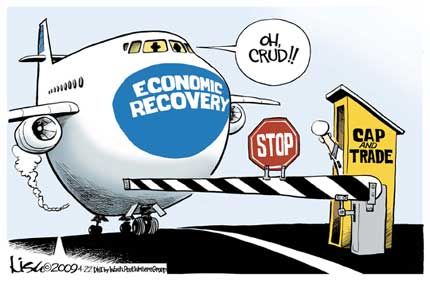
‘Cap and Trade’ Loses Its Standing as Energy Policy of Choice


Less than a year ago, cap and trade was the policy of choice for tackling climate change.
Environmental groups and their foes in industry joined hands to embrace the approach, a market-driven system that sets a ceiling on global warming pollution while allowing companies to trade permits to meet it. President Obama praised it by name in his first budget, and the authors of the House climate and energy bill passed last June largely built their measure around it.

Today, the concept is in wide disrepute, with opponents effectively branding it “cap and tax,” and Tea Party followers using it as a symbol of much of what they say is wrong with Washington.

Mr. Obama dropped all mention of cap and trade from his current budget. And the sponsors of a Senate climate bill likely to be introduced in April, now that Congress is moving past health care, dare not speak its name.

"I don’t know what ‘cap and trade’ means,” Senator John F. Kerry, Democrat of Massachusetts, said last fall in introducing his original climate change plan.

Mr. Kerry’s partner in promoting global warming legislation, Senator Lindsey Graham, Republican of South Carolina, pronounced economywide cap and trade dead last month and has since been working with Mr. Kerry to try to patch together a bill that satisfies the diverse economic, regional and ideological interests of the Senate.
That plan, still being written, will include a cap on greenhouse gas emissions only for utilities, at least at first, with other industries phased in perhaps years later. It is also said to include a modest tax on gasoline, diesel fuel and aviation fuel, accompanied by new incentives for oil and gas drilling, nuclear power plant construction, carbon capture and storage, and renewable energy sources like wind and solar.

Why did cap and trade die? The short answer is that it was done in by the weak economy, the Wall Street meltdown, determined industry opposition and its own complexity.

The New York Times

Congressman Harper's Military Academy Day to be at Madison Central Saturday


U.S. Representative Gregg Harper will hold his annual Third Congressional District Military Academy Day at Madison Central High School on Saturday, March 27, 2010 from 9:00 a.m. to 12:00 p.m.

Military Academy Day is an opportunity for students and parents to learn more about our nation’s military academies, requirements for admission and the appointment process. Harper will be joined by area midshipmen, cadets, alumni and representatives from the five service academies: U.S. Air Force Academy, U.S. Coast Guard Academy, U.S. Merchant Marine Academy, U.S. Military Academy (West Point) and U.S. Naval Academy. The representatives will be present to help answer questions the participants may have about each prestigious institution.

“I encourage all students seeking guidance on obtaining a service academy appointment to take part in this informative informational seminar,” said Congressman Gregg Harper. “I look forward to visiting with the bright young men and women from across the Third Congressional District considering service to our country.”

High school students preparing for college in the approaching years and considering the service academies option should participate. Junior high students are also welcome to attend.

Fervent Republican's overshooting the mark?

In his latest installment Rothenberg writes that Republican's need to tone down the rhetoric and conserve their outrage until November:

calling for repeal of the law moments after the bill’s passage is a statement of ideological faith, a rallying cry for conservatives who never liked the bill and wish it had never passed.


OK. We get it. They didn’t like the bill and don’t like the law. And they voted against it. Fine.

But trying to refight the last war, on the same battlefield and with the same forces, isn’t dedication; it’s political stupidity.

Obviously, repeal is not possible now with Democrats controlling both chambers of Congress and the White House, and by demanding repeal, Republicans look like a bunch of spoiled children who didn’t get their way rather than adults focused on fixing a problem. Voters won’t like that.

From a political point of view, it’s an amateurish mistake. In fact, the Democratic Senatorial Campaign Committee has been goading Republican candidates into taking a stand on repeal for months, understanding the damage that Republicans could do to themselves by making the midterm elections a referendum on themselves, instead of on the president and Congress.

That doesn’t mean Republicans should forget about health care, of course.

Polling has long shown that the public isn’t crazy about the law (forget the quick post-passage polls that reflect short-term events), and as long as Republicans don’t make their quest for repeal into this cycle’s version of the Clinton impeachment zoo, the GOP stands to benefit from the issue in many states and districts this fall.

By demanding repeal immediately after passage, Republicans resemble unsuccessful candidates who keep challenging election results and refuse to concede. Voters don’t like candidates who sound like sour grapes, and they won’t like a party that sounds that way either.

Read the entire article at Rothenberg Political Report

MBJ: Barbour maneuvering for healthcare lawsuit

Gov. Haley Barbour has reaffirmed his commitment to have Mississippi join the multi-state lawsuit challenging the constitutionality of the healthcare reform legislation approved by the U.S. Congress. Barbour made the announcement after Mississippi Attorney General Jim Hood, a Democrat, declined to file a lawsuit by noon, March 25, as asked by Barbour, a Republican.
And, Sen. Thad Cochran (R-Miss.) has made public his “no” vote on the Senate healthcare “fix.”

“I’m trying to save the people of Mississippi from an enormous amount of taxes that would be caused by the Obama Administration’s healthcare plan,” Barbour said. “There is a pivotal constitutional argument that needs to be addressed: Does the federal government have the constitutional authority to force American citizens to buy insurance and then tell them what they can buy and at what price?

Hood notified Barbour March 25 that he needed more time to understand the complexities of a possible legal challenge. Fourteen states already have joined in a lawsuit seeking to stop the administration’s healthcare plan.

Barbour had said that if Hood refused to file the lawsuit, he would do it himself. However, in his March 25 response to Barbour, Hood said the case is under review, and the governor could not file a lawsuit as long as the review continued. Hood did not say how long that review might take.

Mississippi Business Journal
The Guv then let it be known with this Press Release that he had no intention of waiting despite Hood's insistance that the governor must wait on the Attorney General.

Throwing bad money after good

U.S. Plans Big Expansion in Effort to Aid Homeowners


The Obama administration on Friday will announce broad new initiatives to help troubled homeowners, potentially refinancing several million of them into fresh government-backed mortgages with lower payments.

Another element of the new program is meant to temporarily reduce the payments of borrowers who are unemployed and seeking a job. Additionally, the government will encourage lenders to write down the value of loans held by borrowers in modification programs.

The escalation in aid comes as the administration is under rising pressure from Congress to resolve the foreclosure crisis, which is straining the economy and putting millions of Americans at risk of losing their homes. But the new initiatives could well spur protests among those who have kept up their payments and are not in trouble.

The administration’s earlier efforts to stem foreclosures have largely been directed at borrowers who were experiencing financial hardship. But the biggest new initiative, which is also likely to be the most controversial, will involve the government, through the Federal Housing Administration, refinancing loans for borrowers who simply owe more than their houses are worth.

Read the article at The New York Times

McClatchy also has a story on it this morning:

The administration already has such a program in place for second liens, but will be doubling what it offers to lenders in this category to help get them out of the way when modifying a mortgage.

Some of the White House thinking is similar to proposals offered by Rep. Barney Frank, D-Mass., the chairman of the House Financial Services Committee. He was briefed on the plan Thursday.

Frank has proposed making loans from the TARP program to unemployed homeowners with good credit histories. He also shepherded legislation through Congress several years ago to pay banks that were willing to write off large portions of underwater mortgages, or those that exceed the home's underlying value. Lenders showed little interest in taking such losses, however.

Since then, the housing crisis has deepened as the recession piled foreclosures from job losses on top of the foreclosures tied to weak loans, often made to borrowers with the weakest credit.

Thursday, March 25, 2010

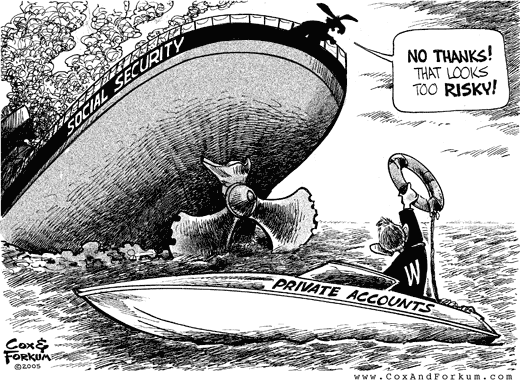
Social Security to See Payout Exceed Pay-In This Year

The bursting of the real estate bubble and the ensuing recession have hurt jobs, home prices and now Social Security.

This year, the system will pay out more in benefits than it receives in payroll taxes, an important threshold it was not expected to cross until at least 2016, according to the Congressional Budget Office.

Stephen C. Goss, chief actuary of the Social Security Administration, said that while the Congressional projection would probably be borne out, the change would have no effect on benefits in 2010 and retirees would keep receiving their checks as usual.

The problem, he said, is that payments have risen more than expected during the downturn, because jobs disappeared and people applied for benefits sooner than they had planned. At the same time, the program’s revenue has fallen sharply, because there are fewer paychecks to tax.

Analysts have long tried to predict the year when Social Security would pay out more than it took in because they view it as a tipping point — the first step of a long, slow march to insolvency, unless Congress strengthens the program’s finances.

The New York Times

The left is outraged over Americans outrage over Congressional Dems outrageous behavior in pushing through an outrageously unpopular Health Care Bill.

The left is outraged at the current level of dissatisfaction among voters despite being told time and again through every poll (even the liberal leaning ones). The election of a Republican to the Senate seat previously held by one of the most liberal members of Congress didn't faze Democrats. In fact, according to the White House, the event was used as a launching pad to double their efforts. Of course, it should have been obvious after the Town Hall meetings last August that the public didn't support the ideas they were hearing. But, instead the seething anger became fodder for Democrats.

No one supports violence or threats against anyone. But, after being told in so many ways that TAXPAYING Americans didn't want this, and to still ignore the will of the people, many of whom are participating in the political process for the first time, is ignorance. Had they really been in touch with the real world they would have seen this coming.


Some observers still can't seem to come to grips with the fact that the outrage is genuine, blaming the current tone on Republicans. Despite the fact that Republicans have denounced violence, Democrats continue to promote these instances for political gain. Which, in turn, has begun to spill over to the very Republicans who have spoken out against it.

The arguments have been many, the parliamentary tricks have been creative. But, in the end, people know a rat when they smell it.

Democrats should stop playing partisan politics with their own members safety. It's time to work together to at least try to calm the outrage.

Related: Want to be a Congressman? Stupak and others targeted and threatened (Listen)
Health Care for ALL Americans . . . except senior officials and their staff
Governor Barbour to add Mississippi to list of states challenging Health Care Bill
Conservative voters to Democrats: "We're coming and hell is coming with us."
Obama to Dem fencesitters: "Time to pick"

OPEN THREAD SOUND OFF: Did State Auditor address Madison Countians concerns?

State Auditor Stacey Pickering's time on the Gallo Radio Show this morning was all about the ongoing calls for a procedural audit in Madison County. He implied that an investigation has been ongoing for some time. While the discussion went on for the majority of Gallo's City/Metro Hour, Pickering didn't elaborate much more than that, saying to give status updates to the people of Madison County would jeapordize the investigation. He said that concerns brought to light by a recent independant investigation were not a surprise, but added that some of those concerns had now been turned over to the Ethics Committee for further review.

Did you listen to the interview?

Are you satisfied with the response by Pickering?

Was this, in your opinion, too late in coming? Or was it simply a matter of leading a responsibly quiet investigation?

Related Posts: "To Audit Or Not to Audit?" That is the questionMadison County Supervisor Asks for Audit of Engineer's Contracts . . . Again.

PERRY/The GOPers eye Lt. Gov.

By BRIAN PERRY

Three Republicans appear likely to enter the race for lieutenant governor in 2011. Senator Billy Hewes of Gulfport announced in fall 2009 he would seek the seat. Auditor Stacey Pickering of Laurel says if and when current Lieutenant Governor Phil Bryant announces he will not seek reelection, that Pickering would shortly afterward announce his intentions. Treasurer Tate Reeves is widely rumored to have decided on a run for this spot, but has not made any official announcement.

Senate District 49 in Harrison County first elected Hewes in 1991 when he won a three-way Republican Primary without a run-off and went on to beat Democrat Phillip Allen with 75 percent of the vote. In every subsequent primary and general election, Hewes was reelected without opposition (1992, 1995, 1999, 2003, 2007) - the only exception being the 1999 primary where Hewes won with 82 percent.

Hewes, an insurance agent and real estate broker, currently serves as President Pro Tempore of the Mississippi Senate, the top leadership position below lieutenant governor. Hewes faces a challenge to increase his name identification statewide, but benefits as the Gulf Coast's "native son" in the race - expecting a sizable share of that region's abundant Republican primary votes. His latest campaign finance report lists more than $670,000 cash-on-hand: well on his way to the war chest necessary for campaign efforts.

Reeves provides one of my favorite examples in breaking the rules of political predictions. I can remember numerous times sitting on Pete Perry's (no relation) Neshoba County Fair cabin porch engaged in the political parlor game of predicting who would be in what office next. Pete always challenged everyone to write their predictions down on a piece of paper and seal them in a box and open them ten years later to see how wrong we all would be. We've never done it - too much like work for Neshoba - but in the years preceding 2003, no one would have written down the name "Tate Reeves."

But in 2003, Reeves came out with a fundraising juggernaut in the three-way Republican Primary for Treasurer. Despite little experience in GOP politics, Reeves led the first primary with 48.6 percent of the vote over a state legislator and a former transportation commissioner and won the run-off with 69 percent of the vote. He went on to win the general election with 51.8 percent over Democrat Gary Anderson and Reform Party candidate Lee Dilworth. Reeves raised more than half-a-million dollars in his first political campaign in a down ticket race. He easily won reelection in 2007 with 60.5 % of the vote facing only perennial candidate Shawn O'Hara. Reeves most recent finance report lists nearly $1.2 million cash-on-hand.

In 2003, Pickering took 52.2 percent of the vote in a three-way Republican Primary in Senate District 42 in Jones County. He defeated Democrat Randy Ellzey in the general election with 58.8 percent of the vote. In 2007, he raised nearly half-a-million dollars to win election as State Auditor facing no primary challenge and defeating Democrat Mike Sumrall in the general election 55 percent to 45 percent. Pickering often serves as a visiting preacher on Sundays.

Read more at the Madison County Journal Online

Senate makes changes, returns reconciliation bill to House

The Associated Press

Senate Republicans learned early Thursday that they will be able to kill language in a measure altering President Obama's newly enacted health care overhaul, meaning the bill will have to return to the House for final congressional approval.

It was initially unclear how much of a problem this posed for Democrats hoping to rush the bill to Obama and avoid further congressional votes on what has been a politically painful ordeal for the party. Democrats described the situation as a minor glitch, but did not rule out that Republicans might be able to remove additional sections of the bill.

The president, who signed the landmark legislation into law on Tuesday, was flying to Iowa later in the day for the first of many appearances he will make around the country before the fall congressional elections to sell his health care revamp. Obama was appearing in Iowa City, where as a presidential candidate in 2007 he touted his ideas for health coverage for all.

His trip comes with polls showing people are divided over the law he signed Tuesday, and Democratic lawmakers from competitive districts hoping he can convince more voters by November that it was the right move.

As an exhausted Senate labored past 2 a.m. on a stack of GOP amendments, Jim Manley, spokesman for Senate Majority Leader Harry Reid, told reporters that Republicans consulting with the chamber's parliamentarian had found "two minor provisions" that violate Congress' budget rules. The provisions deal with Pell grants for low-income students.

Wednesday, March 24, 2010

"To audit or not to audit?" That is the question.

State Auditor Stacey Pickering reportedly will be live on the Paul Gallo Radio Show tomorrow, March 25th at 9:00 am. He is expected to address the ongoing battle in Madison County where residents and at least two of the five Supervisors are requesting a procedural audit of the county's dealings with County Engineer Rudy Warnock.

Some resident activists were on the radio show on March 18. A WAPT report on that same day noted the findings of an independent investigation by Madison Mayor Mary Hawkins-Butler through Detroit-based PMA Consultants. The investigation found potenital illegalities in subcontracting, an issue that has been discussed for several months according to Hawkins-Butler, and the spending of as much as $2 million without proper oversight from the Board of Supervisors.

Warnock has said he is the victim of politics, and that the investigator, Richard J. McAfee, was nothing more than a "hired gun."

"This bears further investigation," McAfee said in an interview. "Any government in the business of serving the people need to have better checks and balances. There are so many inconsistencies it would make sense to perform a thorough audit."

Pickering's office currently has 160 active cases probing misused funds. The state auditor's duties are to protect the public's trust by independently assessing state and local governmental and other entities to ensure that public funds are properly received, spent and reported.

"We are going to pursue each one of these and do it in a fair and just manner," Pickering said of the pending cases.

Pickering has recovered more than $3.6 million in embezzled, misspent or misappropriated funds since being elected in 2007. He announced today that his office has collected more than $1,038,000.00 in unpaid court assessments since February 22, 2010 from counties and municipalities, and that an estimated $1,061,000.00 was yet to be turned in. So, his effectiveness is not in question. The question is will he finally answer a simple question,

"Will you or won't you add this particular audit in Madison County to that list and help the taxpayers of Madison County potentially recover millions?"

And, if the answer is no, "Why not?"

Related articles: Madison County Supervisor Asks for Audit Of Engineers Contracts . . . Again.